Firstly, hello to everyone who is new here. Welcome to my blog! It has been a very long time since I have posted an entry. Working full-time, studying part-time and having a life sure has its challenges but here I am back again ready to share some hopefully thought-provoking insights with you.
As part of my studies this semester I was required to create a video reflecting on the whiteness of the Australian curriculum which I will now share with you. I have to reiterate how limited my understanding of Indigenous cultures, perspectives and knowledge was prior to my undertaking of this Masters level unit. Hopefully, this video summarises some of the key points that need to be shared around this lack of knowledge which is evident in the limited inclusion of Indigenous perspectives embedded in our everyday learning experiences in classrooms across Australia.
This is only a snapshot of the way the Australian Curriculum is written to echo the dominant white Eurocentric ideologies. I hope this short video draws your attention to the minute details of what we teach and how we choose to teach it to ensure that you reconsider the taken-for-granted attitudes that are being reiterated. By keeping this in the back of your mind, you can consciously choose to be more inclusive in your practice!
Please feel free to leave respectful comments or questions so that we can engage in authentic, honest discussion about this important topic!
I’m back! After taking on a new role in a new school this year, I am finally able to get back to writing on my blog. It has been a very exciting start to the year and I am absolutely loving my new role as the Learning Enhancement Teacher at my new school. Part of my job involves working with and supporting teachers to develop their pedagogical practices which is a big part of the reason I started writing this blog in the first place. This post is the first instalment discussing one of the most important aspects of learning in the early years, whether it be in preschool, kindergarten or the first few years of formal schooling it is ABSOLUTELY ESSENTIAL that children continue to play. As part of my studies this semester I was fortunate enough to choose a topic to research in depth and of course as I am so passionate about play I chose to focus on this so the following few blog entries will delve into the research and how this can be implemented in the classroom.
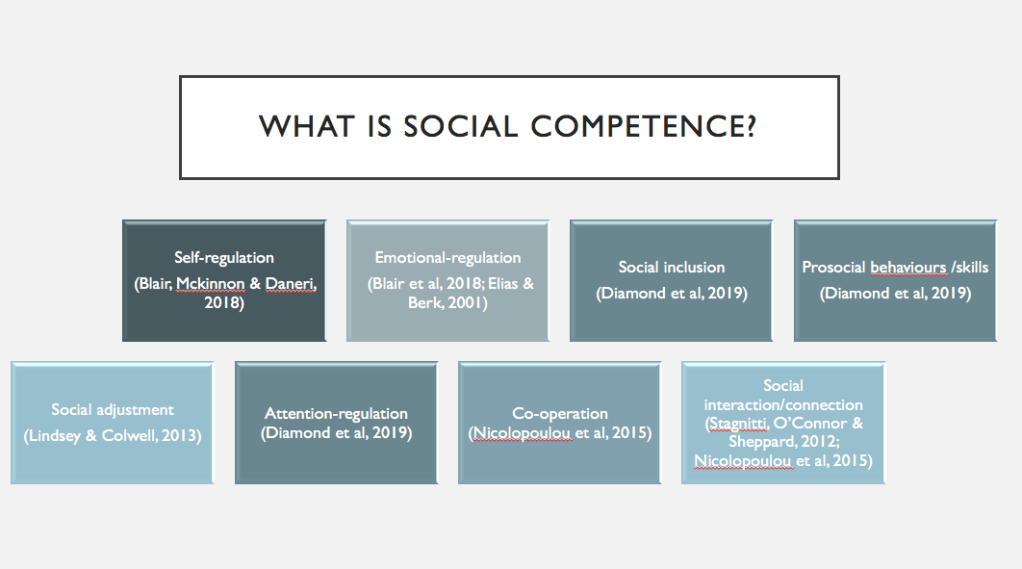
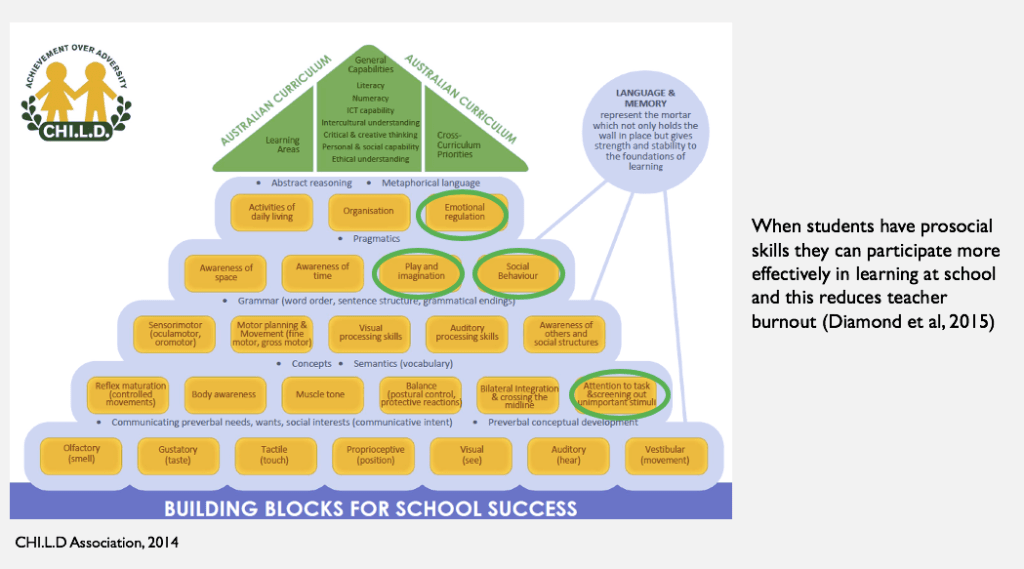
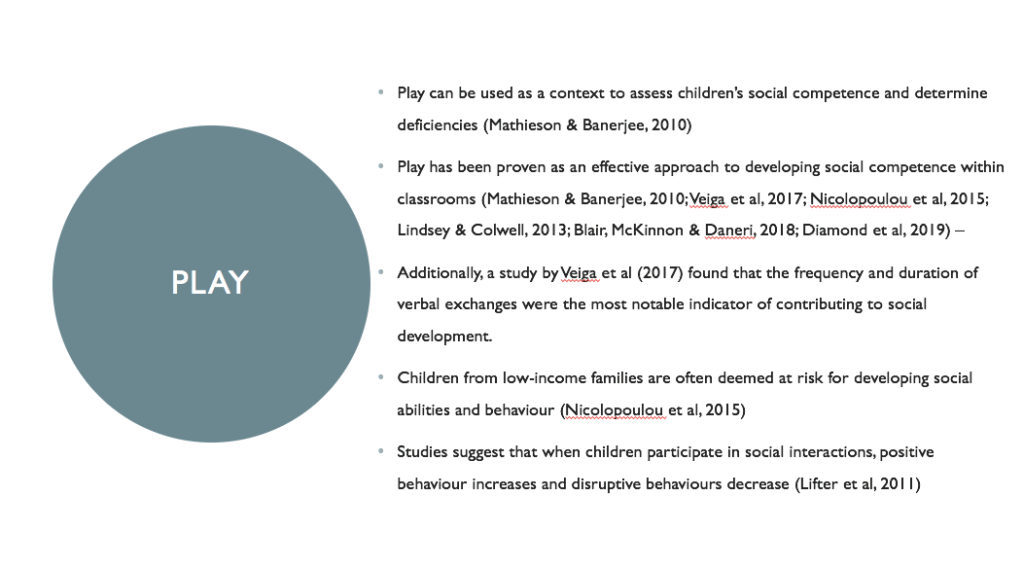
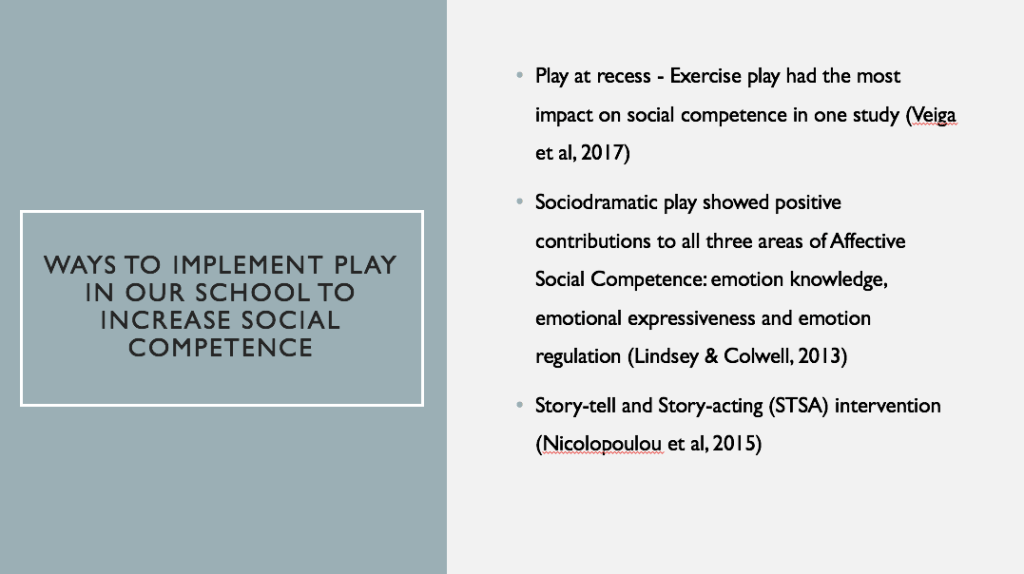
Much of the research on play identifies the importance of play for developing various skills and abilities though this blog entry will focus on the way that play supports the development of social competence.
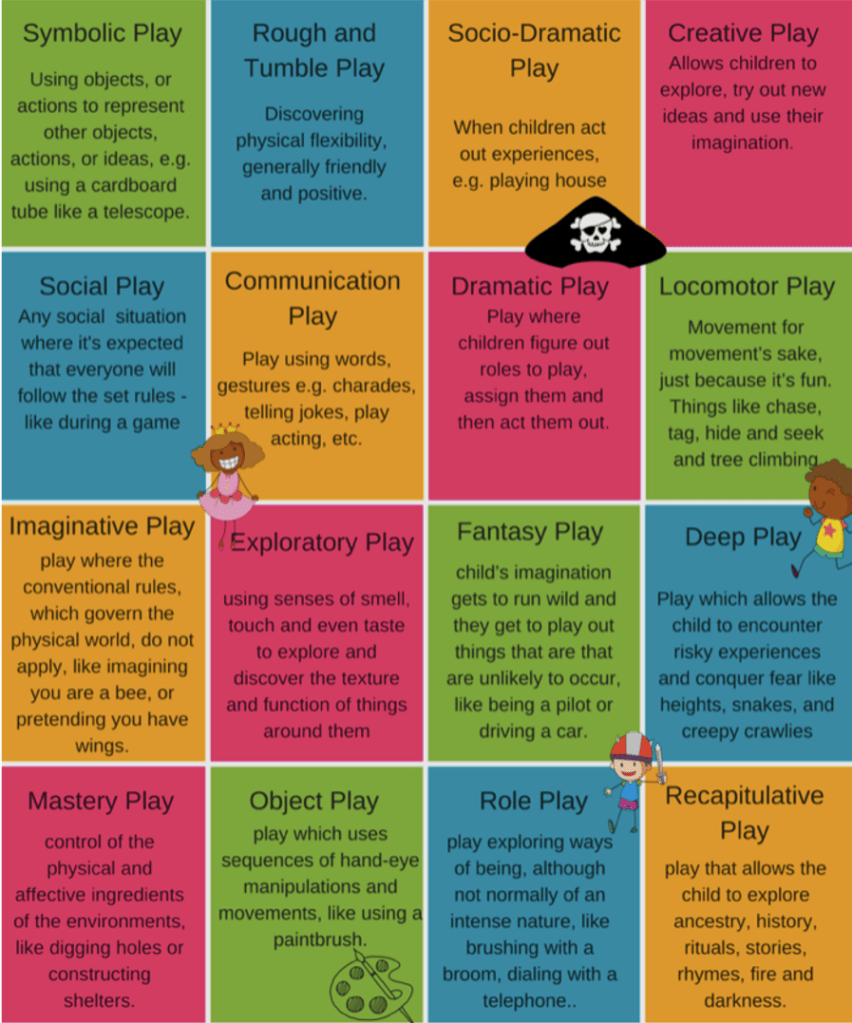
There are many different types of play that children engage in and as they grow and develop these can also vary.
(Hughes, 2002 – image created by encourageplay.com)
Stay tuned for the next blog post to read more on how to implement play in schools. Please share your own thoughts on play in the early years by commenting!
Diamond, A., Lee, C., Senften, P., Lam, A., & Abbott, D. (2019). Randomized control trial of Tools of the Mind: Marked benefits to kindergarten children and their teachers. PloS One, 14(9). DOI: 10.1371/jounoal.pone.0222447
Hughes, B. (2002). A Playworkers Taxonomy of Play Types (Graphic). Retrieved from www.encourageplay.com
Humphries, M. L., Williams, B. V., and May, T. (2018). Early childhood teachers’ perspectives on social-emotional competence and learning in urban classrooms. Journal of Applied School Psychology, 34 (2), 157-179. DOI: 10.1080/15377903.2018.1425790
Leung, C. (2011). An experimental study of eduplay and social competence among preschool students in Hong Kong. Early Child Development and Care, 181 (4), 535-548. DOI: 10.1080/03004431003611487
Lifter, K., Foster-Sanda, S., Arzamarski, C., Briesch, J., and McClure, E. (2011). Overview of play: Its uses and importance in early intervention/ early childhood special education, Infants & Young Children, 24 (3), 225-245. DOI: 10.1097/IYC.0b013e31821e995c
Lindsey, E. W., and Colwell, M. J. (2013). Pretend and physical play: Links to preschoolers’ affective social competence. Merrill-Palmer Quarterly, 59 (3), 330-360. DOI: 10.13110/merrpalmquar1982.59.3.0330
Liu, S., Yuen, M., and Rao, M. (2015). A play-based programme (Pillars of Society) to foster social skills of high-ability and average ability primary-one students in Hong Kong. Gifted Education International, 33 (3), 210-231. DOI: 10.1177/0261429415581221
Stagnitti, K., O’Connor, C., and Sheppard, L. (2012). Impact of the Learn to Play program on play, social competence and language for children aged 5-8 years who attend a specialist school. Australian Occupational Therapy Journal, 59, 302-311. Retrieved from https://doi-org.simsrad.net.ocs.mq.edu.au/10.1111/j.1440-1630.2012.01018.x
Veiga, G., de Leng, W., Cachucho, R, Ketelaar, L., Kok, J. N., Knobbe, A., Neto, C., and Rieffe, C. (2017). Social competence at the playground: Preschoolers during recess. Infant and Child Development, 26, 1-15. DOI: 10.1002/icd.1957


 Chalk and Talk Blog