In a 21st Century classroom digital media and technology play a huge part in all areas of learning. Digital media can be used as a pedagogical tool for presenting content. It can be used as a means for assessment and it can be used as a way to communicate ideas. The following blog post explains various digital media options and explains ways they can be used in the classroom as well as how they support Indigenous Education, following on from my previous blog entry.
I have learned so much about Indigenous Education through the course of my studies, particularly around the significance of building relationships with local community members and Elders to enable cultures to continue to live on within today’s communities. The following various digital media options can be implemented and adapted for all areas of learning in our classrooms.
Digital Escape Rooms
This is such an easy to create, yet very engaging piece of digital media. You have the option of using google docs or One Note. I have been using this process with a group of students that are part of my extension English class. The students have created narratives as their content and devised puzzles, riddles and codes that require solving for each section of their escape room. Following this, they are using One Note (the school’s preferred platform) to create each section and add password protection. This enables the user of the escape room to have to solve the puzzle/problem/riddle and only proceed with the escape room if they input the correct answer. The students have been so engaged thinking about problems and creative narratives as well as editing and reviewing their content to ensure it is suitable for their chosen audience (teachers, Year 6, Year 3 etc). Here is an example that we used to identify features that we must use when creating our own digital escape rooms.
Example: Digital Escape Room
This type of digital media can also be used as a teaching tool to engage your students in new content. In fact, my lecturer used one to support our cultural understanding of his Country and ways of doing and being as a Torres Strait Islander.
Other types of Digital Media
Other types of digital media that we explored both for Indigenous Education and that can be used as learning tools in general include: Augmented Reality apps (Adobe Aero); videos – created by the students or teacher using localised knowledge; 360 degree photos for place-based learning virtually; and interactive podcasts. Podcasts have been a simple learning tool that I have implemented with students of all ages and for various learning areas. From book reviews during book club meetings to sharing a depth of knowledge on a specific topic, they require clear communication skills and often a planned script.
Example: Interactive Podcast
Google street view is an effective app or website to use to plot significant land or story ideas. Another great website to use to create interactive presentations using photos or maps with hotspot links to more information as evident in the above interactive podcast example is Thinglink. Websites such as Powtoon can be used to easily create animated video content to share knowledge and understanding.
Finally, I want to leave you with my key takeaway from my new found knowledge of Indigenous Education that should be considered when planning learning experiences using the Australian Curriculum. The 8Ways of Aboriginal Pedagogy.
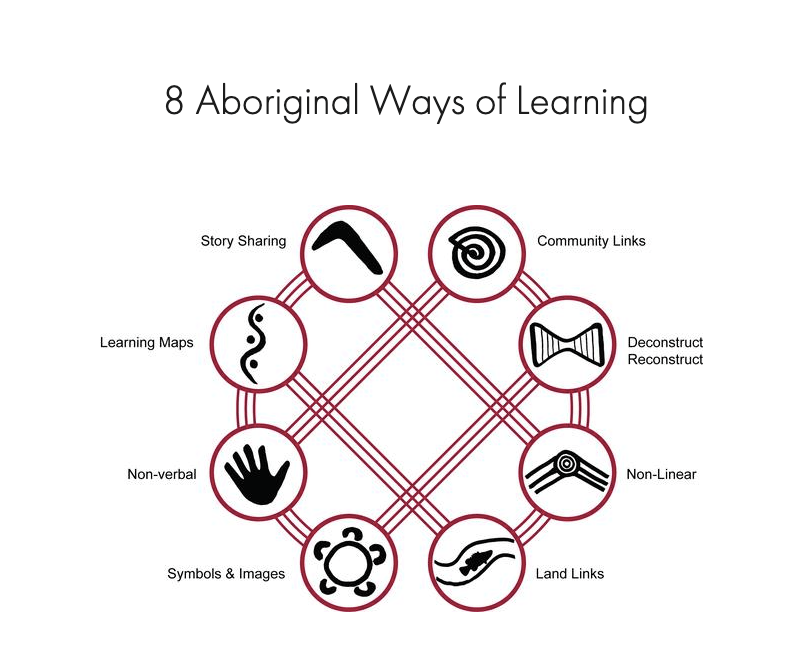
This framework will support your planning and understanding.
Note: There are two distinct groups of Indigenous peoples in Australia: Aboriginal and Torres Strait Islanders. Within these two groups, there are a multitude of variances in beliefs, totems, languages, cultures and practices. It is up to YOU to establish respectful relationships and build your own understanding of your local community.
Feel free to leave comments or questions.

Useful Links
Casey, B. (2018). Some burning issues: Arthur Upfield and the Murchison murders, marginalising Aboriginal people and suggestions on teaching Australia’s history of frontier violence, Australian Aboriginal Studies (Canberra, A.C.T. : 1983), 2018(1), 29–42. https://search-informit-org.simsrad.net.ocs.mq.edu.au/doi/epdf/10.3316/ielapa.719076384366256
Crackerjack Education. (2021). Aboriginal and Torres Strait Islander Protocols: Localising Indigenous Australian Resources. https://www.crackerjackeducation.com.au/cje-content/uploads/2017/08/aboriginal-and-torres-strait-islander-protocols-localising-indigenous-australian-resources-large.pdf
Harrison, N. and Sellwood, J. (2016). Strategies for teaching Aboriginal and Torres Strait Islander students, in N. Harrison (Ed.) Learning and Teaching in Aboriginal and Torres Strait Islander Education, 70-99, South Melbourne: Oxford University Press. https://ap01.alma.exlibrisgroup.com/leganto/public/61MACQUARIE_INST/citation/36255458120002171?auth=SAML
OECD. (2017). Supporting Success for Indigenous Students. https://ilearn.mq.edu.au/pluginfile.php/6816701/mod_folder/content/0/Supporting%20Success%20for%20Indigenous%20Students.pdf?forcedownload=1
Queensland Studies Authority [QSA]. (2010). Dialogue Circles. https://www.qcaa.qld.edu.au/downloads/approach2/indigenous_res_dialogue_circ.pdf
Queensland Studies Authority [QSA]. (2013). Aboriginal and Torres Strait Islander histories and cultures resources: English Supporting the implementation of the Australian Curriculum cross-curriculum priorities. https://www.qcaa.qld.edu.au/downloads/aust_curric/ac_ccp_atsi_cultures_english.pdf
The Healing Foundation. (2021). Stolen Generations Resource Kit for Teachers and Students. https://healingfoundation.org.au/schools/
The Yarning Circle. (2021). Let’s Have a Yarn with Yarn. Retrieved 30/4/2021 https://www.theyarningcircle.com/face-to-face/

 Chalk and Talk Blog