In the previous blog post I wrote about why play is essential in the early years. This is particularly important in the first few years of primary school as in the current data-driven approach to education play can be dismissed as unwarranted busy work. Many times I’ve heard teachers share their concerns of not having enough time for the students to play and learn, however, the research identifies play as a vehicle for learning (Mathieson & Banerjee, 2010; Veiga et al, 2017; Nicolopoulou et al, 2015; Lindsey & Colwell, 2013; Blair, McKinnon & Daneri, 2018; Diamond et al, 2019) . There are multiple ways that play can be incorporated in learning in a school context.
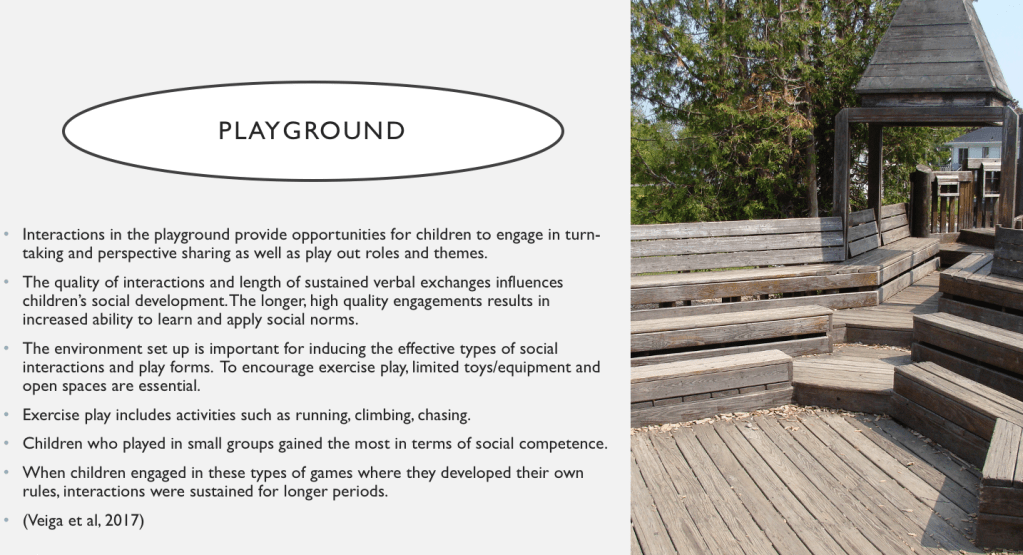
Outside learning at lunch time:
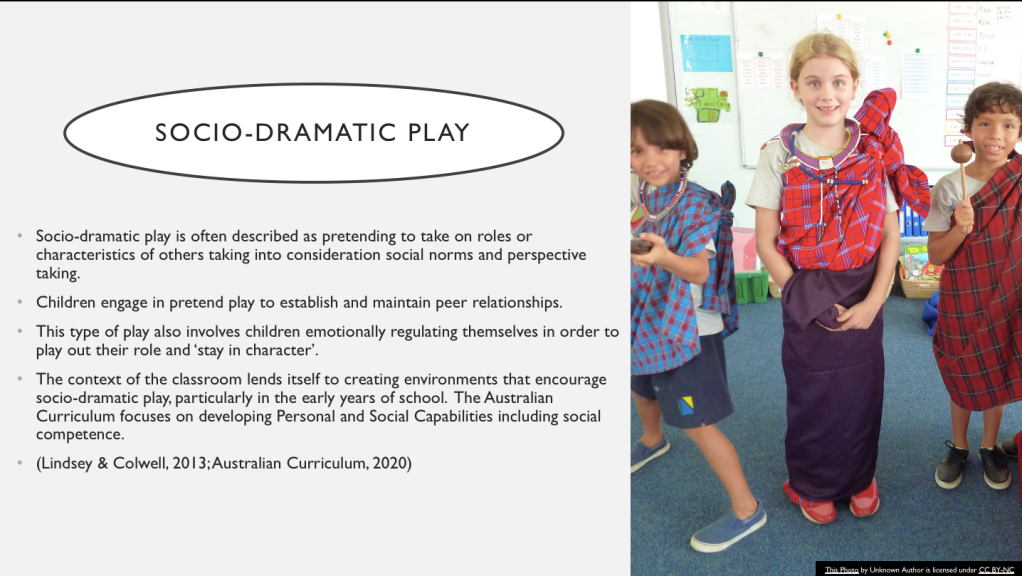
Learning within the classroom:
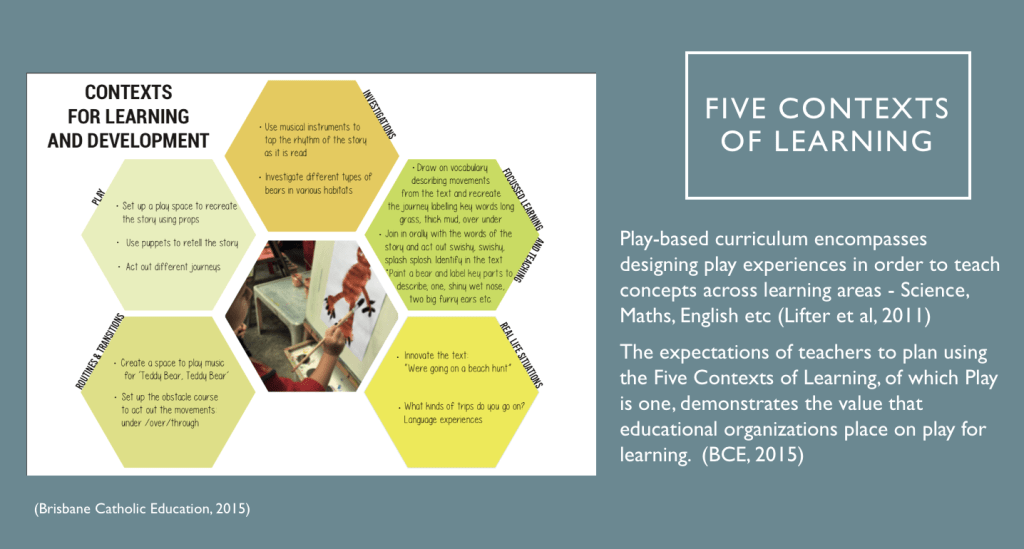
In order to effectively contextualise learning for students, experiences should be planned in a range of contexts including routines and transitions, play, real life situations, investigation and focused learning.
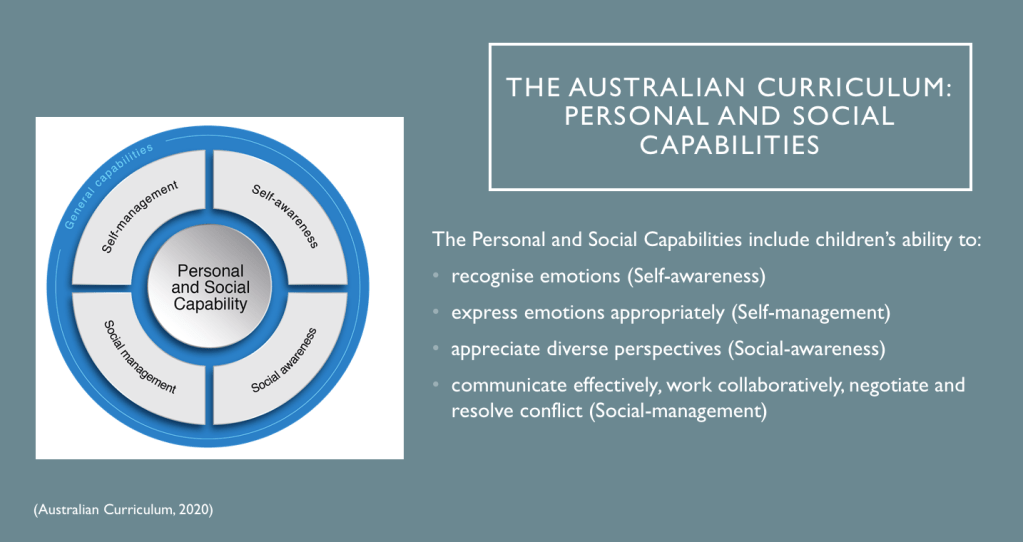
Learning through play is highlighted within the Australian Curriculum throughout the Personal and Social Capabilities. Skills and knowledge that students should be developing and learning are evident within the four areas: self-management, self-awareness, social management and social awareness.
There are many more ways to incorporate learning through play. In the next blog post I will explain the concept of using play as a context for assessment and intervention. Please feel free to share your ideas of learning through play in the comments!
Mrs W ✍🏻
References
Australian Curriculum. (2020). Personal and Social Capabilities. Retrieved from https://www.australiancurriculum.edu.au/f-10-curriculum/general-capabilities/personal-and-social-capability/
Blair, C., McKinnon, R. D. and Daneri, M. P. (2018). Effect of the Tools of the Mind kindergarten program on children’s social and emotional development. Early Childhood Research Quarterly, 43, 52-61. Retrieved from https://www-sciencedirect-com.simsrad.net.ocs.mq.edu.au/science/article/pii/S0885200617300613?via%3Dihu
Brisbane Catholic Education. (2015). Five Contexts of Learning. Retrieved from closed link.
Diamond, A., Lee, C., Senften, P., Lam, A., & Abbott, D. (2019). Randomized control trial of Tools of the Mind: Marked benefits to kindergarten children and their teachers. PloS One, 14(9). DOI: 10.1371/jounoal.pone.0222447
Lifter, K., Foster-Sanda, S., Arzamarski, C., Briesch, J., and McClure, E. (2011). Overview of play: Its uses and importance in early intervention/ early childhood special education, Infants & Young Children, 24 (3), 225-245. DOI: 10.1097/IYC.0b013e31821e995c
Lindsey, E. W., and Colwell, M. J. (2013). Pretend and physical play: Links to preschoolers’ affective social competence. Merrill-Palmer Quarterly, 59 (3), 330-360. DOI: 10.13110/merrpalmquar1982.59.3.0330
Mathieson, K., and Banerjee, R. (2010). Pre-school peer play: The beginnings of social competence. Educational and Child Psychology, 27 (1), 9-20. Retrieved from http://growinggreatschoolsworldwide.com/wp-content/uploads/2018/02/ECP27_1-Mathieson-Banerjee.pdf
Nicolopoulou, A., Schnabel Cortina, K., Ilgaz, H., Brockmeyer Cates, C., and de Sa, A. B. (2015). Using a narrative- and play-based activity to promote low-income preschoolers’ oral language, emergent literacy, and social competence. Early Childhood Research Quarterly, 31, 147-162. Retrieved from https://www-sciencedirect-com.simsrad.net.ocs.mq.edu.au/science/article/pii/S0885200615000071?via%3Dihub
Veiga, G., de Leng, W., Cachucho, R, Ketelaar, L., Kok, J. N., Knobbe, A., Neto, C., and Rieffe, C. (2017). Social competence at the playground: Preschoolers during recess. Infant and Child Development, 26, 1-15. DOI: 10.1002/icd.1957

 Chalk and Talk Blog